Care for the elderly and people with disabilities is at a critical turning point.
We are getting older, living longer with chronic conditions, and at the same time, we are seeing increasing pressure on healthcare professionals. The question that is becoming increasingly pressing is not only how we can continue to provide quality care, but above all, how we can support people in living independently, actively, and meaningfully for as long as possible.
At the same time, the focus is shifting more and more from care to prevention, from treatment to empowerment, and from dependence to self-determination.
Exercise, technology, and collaboration play a crucial role in this development.
A Growing Challenge in Long-Term Care
We are seeing similar social trends in both elder care and care for people with disabilities.
The demand for care is increasing. People are living at home longer. The complexity of care is growing, and at the same time, the labor market is under pressure. Organizations are looking for ways to continue providing high-quality care, even as available capacity becomes increasingly scarce.
At the same time, research shows that physical activity is one of the most important predictors of health, participation, and self-reliance.
People who stay active maintain their strength, balance, mobility, and self-confidence for longer.
This applies to older adults, but certainly also to people with physical, intellectual, or multiple disabilities. Physical activity not only contributes to physical health, but also supports independence, well-being, and quality of life.
Fall prevention is more than just preventing falls
When we talk about fall prevention, many people immediately think of older adults who are at risk of a hip fracture or hospitalization.
That attention is well-deserved.
Every year, tens of thousands of older adults end up in the emergency room as a result of a fall. The consequences can be severe: a long recovery, loss of independence, and a greater reliance on support.
But fall prevention is about much more than just safety.
It’s about:
- Increasing Self-Reliance
- Supporting Self-Direction
- Actively participating in daily life
- Strengthening Both Physical and Mental Health
Fall prevention is therefore not only a healthcare issue, but above all a matter of vitality, participation, and quality of life.
That is precisely why this issue affects not only elder care, but also care for people with disabilities, rehabilitation care, and other areas where maintaining functional ability is a central concern.
The Power of Movement
Research shows that factors such as balance, muscle strength, and mobility are directly linked to the risk of falling. The good news is that these factors can be influenced.
Targeted physical activity interventions can contribute to:
- Improving Balance
- Increase in muscle strength
- Increasing Mobility
- Greater self-confidence in daily activities
- Reducing the Risk of Falls
Still, that presents an immediate challenge.
Many exercise programs are effective, but keeping participants motivated over the long term often proves difficult. Not because people don’t understand the importance of exercise, but because for many, exercise isn’t a natural part of their daily routine.
That is why the question is increasingly shifting from:
“How do we get people to exercise?”
to:
“How can we make physical activity appealing, meaningful, and fun?”
This calls for new forms of support that align with the experiences of clients, residents, and participants.
Technology as a means, not an end
In recent years, technology has played an increasingly prominent role in long-term care.
From smart devices and monitoring to digital treatment methods and innovative training approaches: technology offers opportunities to help people become more independent and provide healthcare professionals with more support.
But successful innovation is never just about technology.
True value is created when technology solves a specific problem or addresses a clear need.
For example, by:
- Enabling people to take more control of their own lives
- Encouraging Participation in Therapy
- Increasing Motivation to Exercise
- Supporting Independence
- To provide healthcare professionals with additional opportunities
When technology is used in this way, it creates opportunities for sustainable behavioral change and better healthcare outcomes.
Mixed Reality as a New Generation of Physical Activity Interventions
One of the most promising developments in long-term care is the emergence of Mixed Reality (MR).
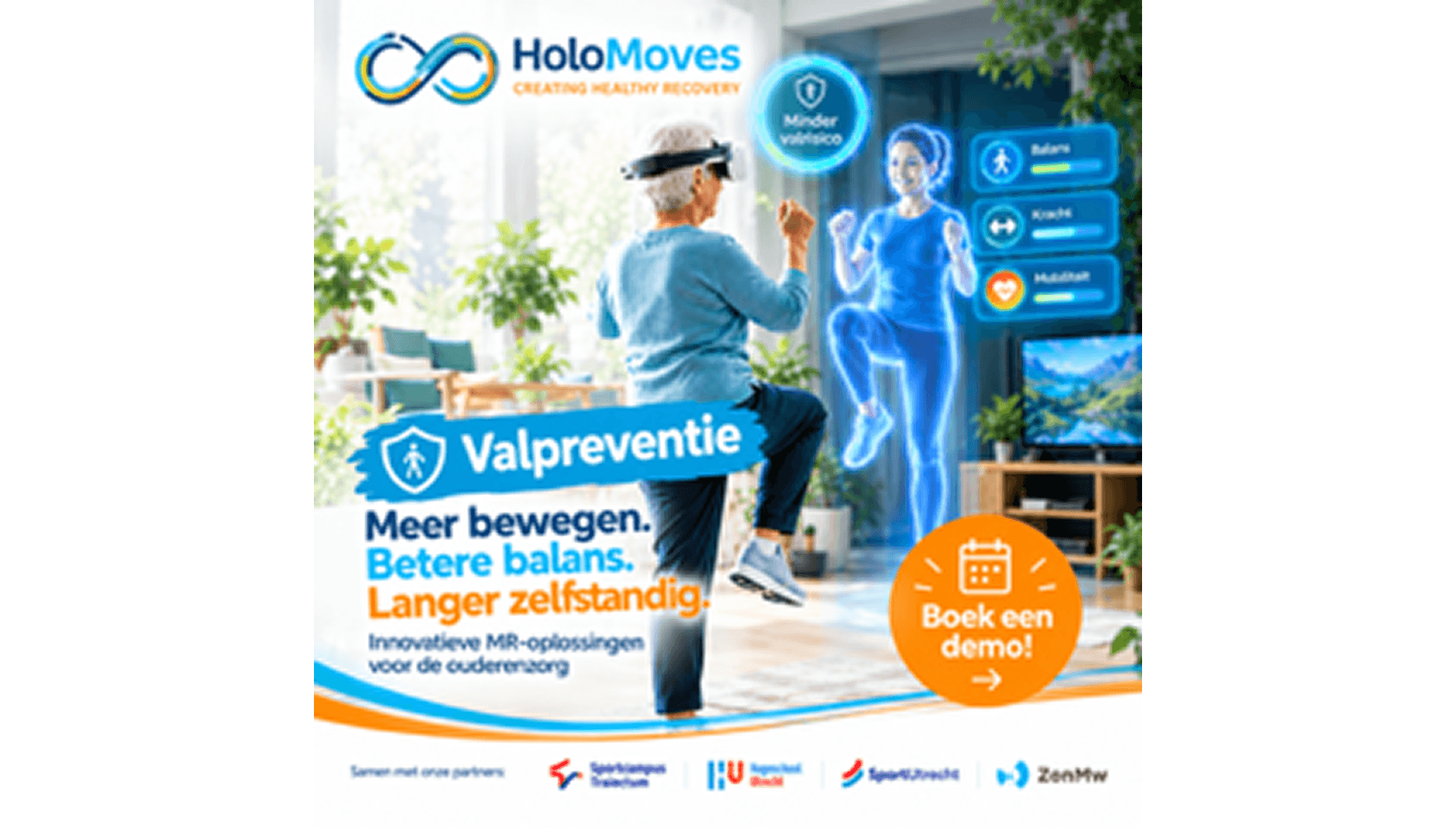
Mixed Reality combines the physical environment with interactive digital elements. This creates a new way of training that brings together movement, motivation, and experience.
While traditional exercises are sometimes perceived as repetitive, Mixed Reality creates an environment in which people actively participate because they want to, not because they have to.
In the fields of elder care and disability care, this offers opportunities for:
- Balance Training
- Strength Training
- Mobility Exercises
- Cognitive Activation
- Rehabilitation
- Fall Prevention
- Self-reliance and autonomy
What healthcare professionals observe in practice is that enjoyment and engagement are key factors for continued participation.
When exercise is made challenging, interactive, and motivating, participants are more likely to stay active and, as a result, actually achieve health benefits.
Innovation comes from collaboration
Technology alone is never the solution.
Real impact is created when healthcare organizations, academic institutions, researchers, municipalities, social service organizations, and technology partners collaborate to address shared societal challenges.
The complex challenges in elder care and care for people with disabilities call for a comprehensive approach that brings together practical experience, scientific knowledge, and technological innovation.
That is why there is an increasing focus in the Netherlands on regional cooperation, knowledge sharing, and joint innovation programs.
These partnerships ensure that new insights don’t remain on the drawing board, but actually find their way into everyday practice.
That is essential.
Because the biggest challenge is often not developing innovative solutions, but successfully implementing them within existing healthcare processes.
The future calls for a different approach to healthcare
In the coming years, we will need to take a different approach to health and support.
The focus is no longer on the disability, medical condition, or care needs.
More and more often, the question is:
How can we help people reach their full potential?
That requires:
- Greater Focus on Prevention
- Greater emphasis on self-direction
- Smart Use of Technology
- Stronger collaboration across domains
- New Ways to Make Exercise Appealing
The future of healthcare is not determined solely by what we treat.
It is determined primarily by what we help prevent.
From Care to Opportunities
At Holomoves, we believe that movement is one of the most powerful ways to improve health, independence, and quality of life.
That is why we develop solutions that focus not on technology, but on people.
Solutions that help older adults stay active and healthy for longer.
Solutions that help people with disabilities become more independent.
Solutions that help healthcare professionals work more effectively and enjoy their work more.
After all, fall prevention isn’t just about preventing a fall.
It’s all about trust.
It’s about independence.
It’s about taking control of your own life.
And above all: it’s about being able to continue participating in daily life.
Experience the possibilities of Mixed Reality in long-term care for yourself
Are you curious about how Mixed Reality can help promote physical activity, increase independence, and effectively prevent falls within your organization?
Whether you work in elder care, care for people with disabilities, rehabilitation, social services, or the social sector, innovative exercise technology offers new ways to get people moving—and keep them moving—in a sustainable way.
Schedule a no-obligation demo
Discover how Holomoves supports organizations in:
✓ Fall prevention and improved balance
✓ Increasing independence
✓ Promoting physical activity and vitality
✓ Boosting motivation and engagement
✓ Innovation in daily care practice
“The future of healthcare isn’t just about providing more care, but about creating more opportunities.” – Holomoves